

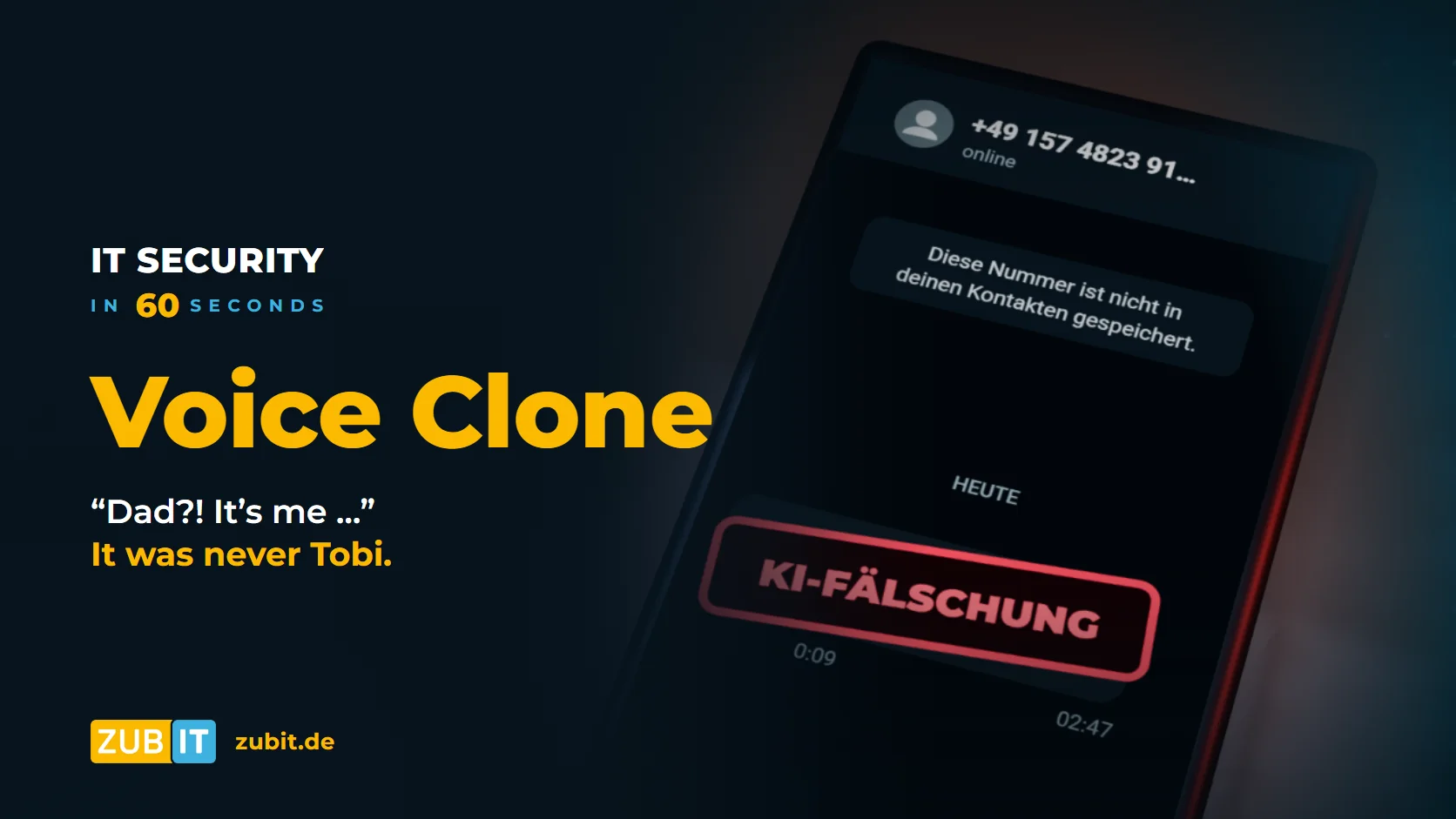
“Dad?! It’s me … I’ve had an accident. I need money right now – please, don’t call Mum!”
In the middle of the night, a voice message arrives from an unknown number. The voice sounds exactly like your own child. But it was never Tobi.
In short: What is a voice clone?
With a voice clone, an AI uses recordings of a real person to create an artificial voice that sounds just like them. It can then speak any sentence the person never said. Fraudsters use this for shock calls to families and for CEO fraud in companies: the supposed boss gets in touch and demands an urgent bank transfer.
A short video can be enough
A voice clone no longer requires hours of recordings. Sources mention a few seconds to a few minutes of audio, for example from social media videos, voice messages or phone calls. That is why the police have been warning about shock calls with AI voices for some time.
The scene in the video is staged, but the scam behind it is not: fear, pressure and haste are meant to stop people from thinking or asking questions.
In companies: around 25 million US dollars after a video call
In early 2024, the engineering firm Arup was hit. An employee in its Hong Kong office received a message about a confidential transaction. He then joined a video call with the supposed chief financial officer and other colleagues. Everything looked real. According to the police, however, the participants were digital fakes.
In 15 transactions to five accounts, the employee transferred a total of around 200 million Hong Kong dollars, about 25 million US dollars. The fraud only came to light when he checked with head office. Arup confirmed the case in May 2024 (report on Dezeen).
What helps
A good voice clone can hardly be recognised by its sound. So do not rely on your ears, but on fixed rules:
1. Always call back on the known number
If money or new bank details are involved, call back, and do so on the number you already know: the saved contact or the number from the company directory. Never on the number from the message or the call. This also applies when someone is in a hurry or asks for secrecy, because that is exactly part of the scam.
2. Four-eyes principle for bank transfers
No single person approves bank transfers or changed bank details alone. A second person checks and confirms. That stops a fraud even when the first person is already convinced.
3. Only allow known partners in Microsoft Teams
Fraudsters also get in touch via Teams, for example as a supposed boss or IT support from another organisation. In the Teams admin center, under Users › External access, you can specify that chats and calls with other organisations are only allowed for specific external domains (setting “Allow only specific external domains”). There you add the domains of your known partners (Microsoft documentation).
Important: this setting slows down fake chats and calls via Teams. It does not reliably prevent a case like Arup, because depending on the settings, meetings can also be joined anonymously via a link, and fraudsters switch to other platforms. There, calling back and the four-eyes principle protect you most.
4. In private: agree on a code word
Agree on a code word within your family that only you know and that appears nowhere online. If a call seems suspicious, ask for it, however familiar the voice sounds. In a company, fixed rules take on this role: who may order payments, and through which channel?
Call back first, then decide
No technology detects every voice clone. A call back on the known number, on the other hand, works no matter how real the fake sounds. Why several layers of protection work better than one is explained in our article A firewall is not enough: defense in depth.
Checklist for your business
- Are payment requests and new bank details always verified via a known number?
- Does the four-eyes principle apply to bank transfers and changed bank details?
- Are external chats and calls in Microsoft Teams limited to known partner domains?
- Does everyone on the team know that haste and secrecy are typical warning signs?
- Is there a code word for emergencies in your family?
Conclusion
A familiar voice alone proves nothing today. If you always call back on the known number when money or bank details are involved, approve transfers using the four-eyes principle, limit Teams to known partners and have a code word in private, you take away the fraudsters’ leverage. And however real the voice on the phone sounds: call back first, then decide.
IT security at zubIT
Stop voice fraud in its tracks
As a Microsoft Solutions Partner, we set up external access in Microsoft Teams securely for your company and help you define clear approval and call-back rules for payments. That way, a fake call does not turn into a bank transfer.
More from the series “IT Security in 60 Seconds”
- Conditional Access in Microsoft 365: When a Sign-in from Singapore Just Goes Through
- A Firewall Is Not Enough: Why IT Security Today Needs Many Layers
- Shadow AI in the Workplace: When the Customer List Ends Up in an AI Tool
- Emergency Access for Microsoft 365: How to Set Up a Break-Glass Account Properly
- Network Segmentation: One Domino May Fall. The Company Must Not.
- VPN vs. Zero Trust: Why Your VPN Opens the Entire Network
- Token Theft: How Attackers Get Into Microsoft 365 Despite MFA
- USB Trap: Why a Found USB Stick Becomes a Security Risk
- Fish Tank Hack: Why Every Connected Device in the Office Is a Door Into the Network
FAQ: Common questions about voice cloning
How much audio is needed to clone a voice?
Sources mention a few seconds to a few minutes of audio, for example from social media videos, voice messages or phone calls. Even a short video can therefore be enough.
What happened at the company Arup?
In early 2024, an employee in the Hong Kong office of the engineering firm Arup transferred around 200 million Hong Kong dollars, about 25 million US dollars, in 15 transactions after a video call with the supposed chief financial officer. According to the police, the participants were digital fakes. Arup confirmed the case.
How can you recognise a call with a cloned voice?
Often not by its sound at all. Typical warning signs are time pressure, secrecy and demands for money or new bank details. The most reliable step is to call back on the number you already know.
How can a company protect itself against deepfake CEO fraud?
Always verify payment requests and new bank details via a known number, approve transfers using the four-eyes principle and limit external chats and calls in Microsoft Teams to known partner domains. The Teams setting slows down fake calls via Teams, but does not replace calling back and the four-eyes principle.