

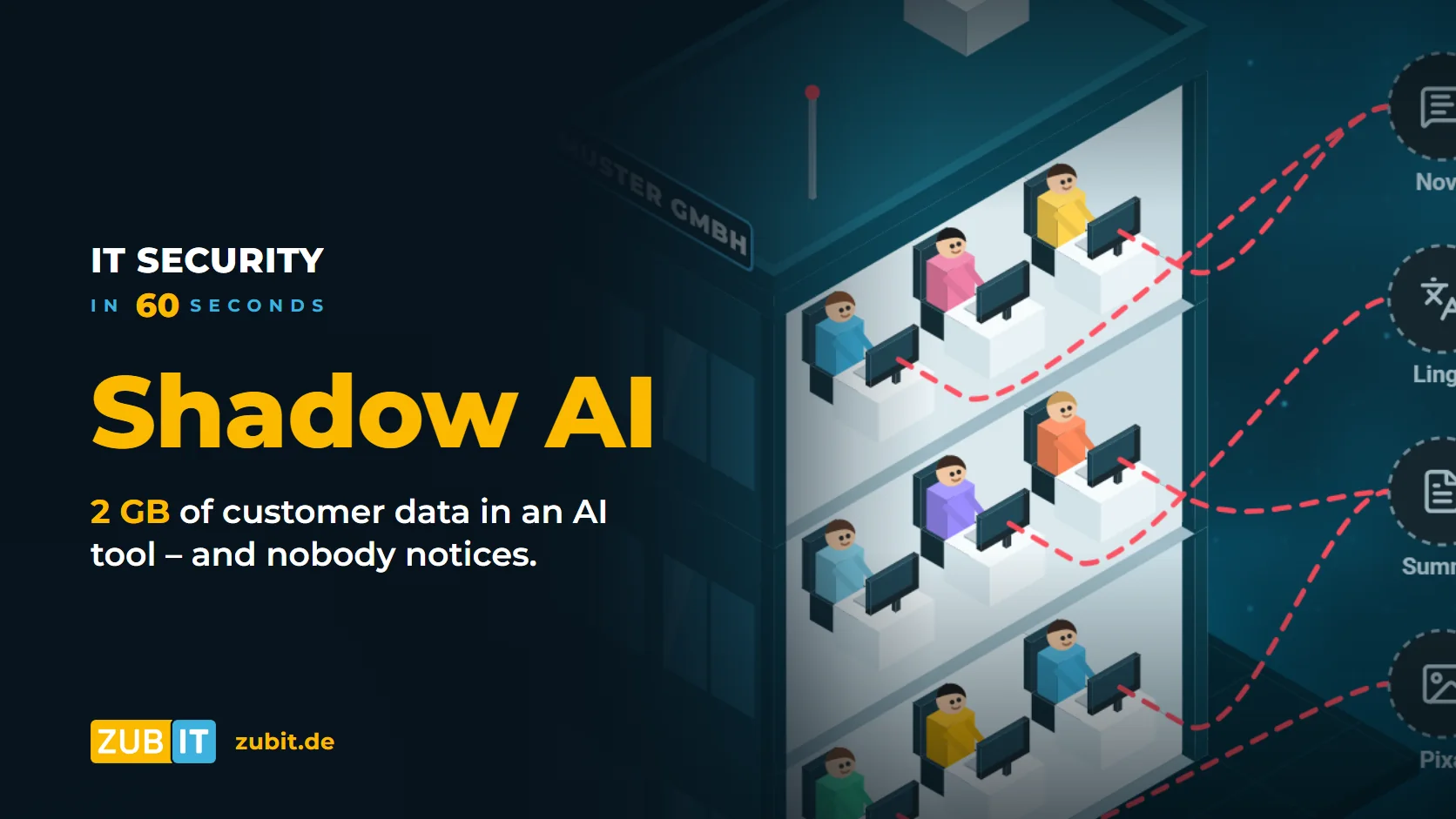
Someone in your sales team has just copied the entire customer list into an AI tool. 2 gigabytes. And nobody noticed.
There is almost never bad intent behind it. One colleague wants to analyse the list faster, another wants to write a quote faster. AI tools do this in seconds – for free, right in the browser. That is exactly why today it is no longer single files but entire folders that end up in services nobody in the company has approved.
In short: What is shadow AI?
Shadow AI refers to AI applications that employees use without the knowledge or approval of IT – for example free chatbots, translators, summarisers or image generators with a private account. The company then does not know which data goes where.
Why shadow AI is a risk
The problem is not AI itself but the lack of control. With a tool that nobody has approved, it is unclear:
- Which tools are used at all and by whom.
- Where the data is stored – in the EU or somewhere else.
- Whether the data is used to train AI models, which is possible with many free plans.
- Who has access when a private account is used and the employee leaves the company.
The company still carries the risk: under data protection law when personal customer data is involved, and for trade secrets such as prices, quotes or design data.
Why a ban does not help
The obvious reflex is to simply ban AI tools. In practice, this only moves usage to private phones, where IT sees nothing at all. The opposite approach works better: make AI visible, set clear rules and offer an official tool that is set up securely.
Three steps to safe AI use
1. Create visibility
First, you need to know what is actually being used. With Microsoft Defender for Cloud Apps (Cloud Discovery), it becomes visible which cloud and AI apps are used in the company – including users, devices and data volume. The result is often surprising: instead of the expected two tools, there are twenty.
2. Approve what fits – block what does not
Based on this overview, you decide: Which apps are fine and get approved, and which pose a risk and get blocked? In addition, a short AI policy defines which data may go into which tools and which never may.
3. Provide an official AI tool
Giving employees a good, securely configured AI tool removes their reason to look elsewhere. In Microsoft 365, this is for example Microsoft 365 Copilot Chat with enterprise data protection: sign-in uses the company account, and prompts are not used to train the models.
Good to know: AI literacy is mandatory
Since February 2025, the EU AI Act requires companies that use AI to ensure sufficient AI literacy among their staff. A short training on approved tools and sensitive data covers this point and at the same time reduces the risk of shadow AI.
Conclusion
Shadow AI comes from good intentions, and that is exactly why it gets overlooked. The answer is not a ban, but: visibility first, then control – and an official AI tool so that nobody has to look elsewhere.
AI consulting at zubIT
Use AI safely in your business
As a Microsoft Solutions Partner, we make sure AI is used safely in your business – with visibility, clear rules and a properly configured AI tool.
More from the series “IT Security in 60 Seconds”
FAQ: Common questions about shadow AI
What is shadow AI?
Shadow AI refers to AI applications that employees use without the knowledge or approval of IT, such as free chatbots with a private account. The company then does not know which data goes where and whether it is used for training.
How can I detect shadow AI in my company?
Tools such as Microsoft Defender for Cloud Apps (Cloud Discovery) show which cloud and AI apps are used, by which users and devices, and with what data volume.
Should companies ban AI tools?
A ban alone usually moves usage to private phones. It is better to make usage visible, approve suitable tools, block risky ones and provide an official, securely configured AI tool.
What belongs in an AI policy?
An AI policy defines which AI tools are allowed, which data may be entered and which never may, for example personal customer data or trade secrets, and who to ask for help.