

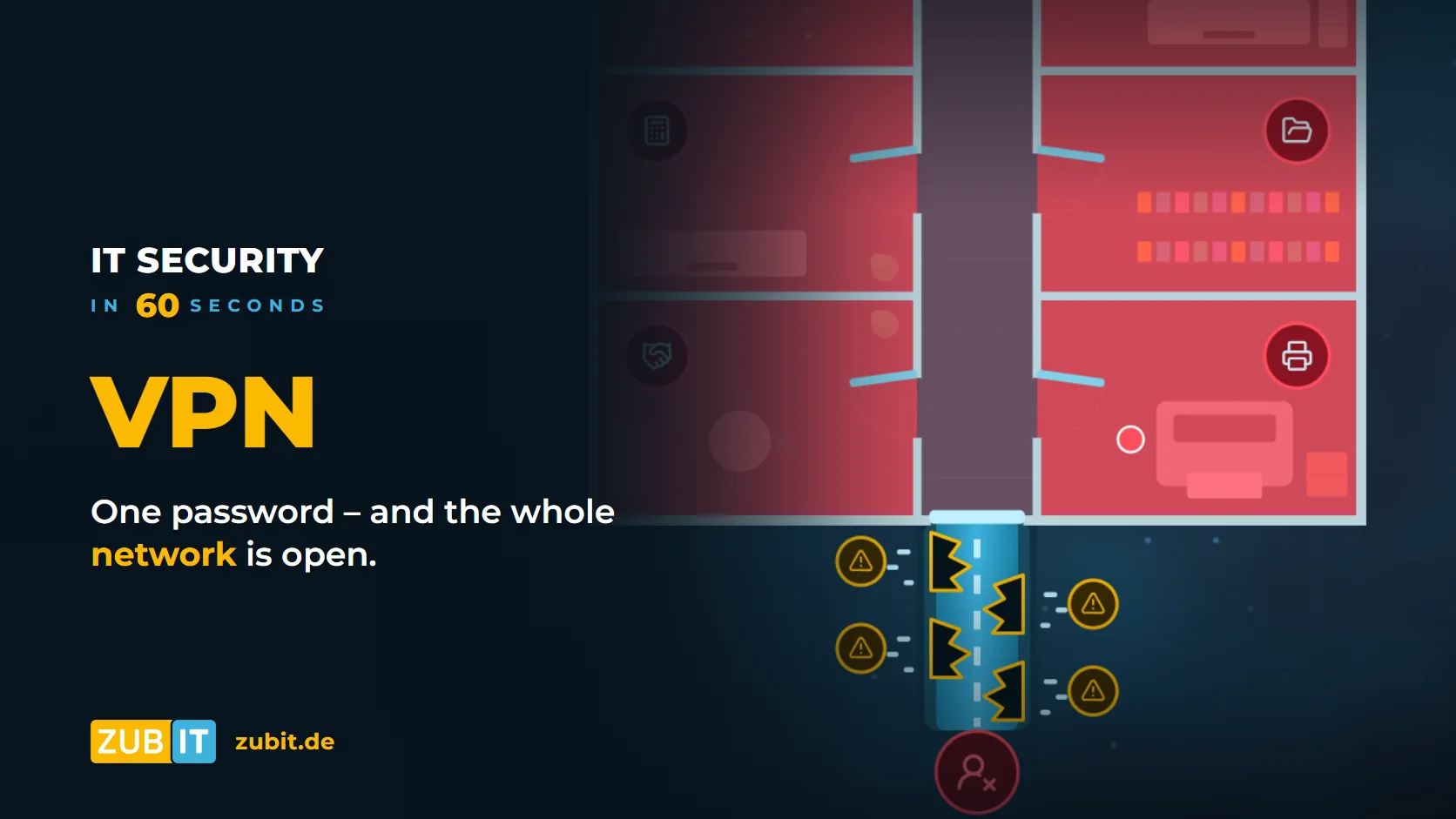
Monday, 7:10 a.m. Someone connects to your company via VPN. With a real password – but they are not an employee. From now on, your entire network is open to them.
That is exactly the problem with classic VPN. It builds a tunnel into the company network but does not ask who is coming, on which device and what they actually want there. Once inside, every door is reachable: servers, files, printers.
In short: What is Zero Trust Network Access?
Zero Trust Network Access (ZTNA) is the successor to classic VPN. Instead of opening up the entire company network, each person gets access to exactly the applications they need. Every access is checked: who is signing in, on which device and for which application?
The problem with classic VPN
A VPN works at the network level. After sign-in, the remote device is connected to the company network as if it were sitting in the office. That is convenient, but it has consequences:
- A password is enough: Anyone with valid credentials, for example from a phishing email or an infected private computer, is in.
- Everything is reachable: servers, file shares, printers, often admin interfaces too, whether the person needs them or not.
- The device is not checked: Whether the computer is managed, encrypted and up to date does not matter to the tunnel.
The VPN as an entry point
On top of that, many VPN products have had serious security vulnerabilities in recent years. Because the VPN gateway is directly reachable from the internet, the access point that is supposed to protect you becomes a target itself. Anyone exploiting such a vulnerability does not even need a password.
The successor: Zero Trust Network Access
Zero Trust turns the principle around. Trust is not granted to the network as a whole, but anew for every single access:
- Applications instead of the network: What gets opened is not the company network but a specific application.
- A check with every access: Who is the person, is the device a managed company device, which application is requested?
- Only the matching traffic: Only the traffic for exactly this application gets through. Accounting gets to the accounting software – and nothing else.
- Older programs too: This works not only for cloud services but also for applications on your own server.
The checks on person and device build on the same rules as Conditional Access in Microsoft 365. Read more in our article Conditional Access in Microsoft 365.
At Microsoft: Global Secure Access
Microsoft offers Zero Trust Network Access under the name Global Secure Access. There are other good providers too – what matters is the principle: do not open the whole building, open exactly one room.
How to replace your VPN step by step
- Take stock: Which applications are really needed from outside, and by whom?
- Define access per application: Which group may use which application, and only from company devices?
- Pilot group: Test Zero Trust with a few employees first while the VPN keeps running.
- Switch over and shut down: After the pilot, move everyone over and switch off the old VPN access so it does not remain an open door.
Conclusion
With one password, a VPN opens the entire company network. Zero Trust only opens what a person really needs and checks every time who is coming and on which device. Do not open the whole building – open exactly one room.
IT security at zubIT
Replace your VPN with Zero Trust
As a Microsoft Solutions Partner, we replace your old VPN with Zero Trust – including an inventory of which applications are really needed from outside, and a test with a pilot group.
More from the series “IT Security in 60 Seconds”
- Conditional Access in Microsoft 365: When a Sign-in from Singapore Just Goes Through
- A Firewall Is Not Enough: Why IT Security Today Needs Many Layers
- Shadow AI in the Workplace: When the Customer List Ends Up in an AI Tool
- Emergency Access for Microsoft 365: How to Set Up a Break-Glass Account Properly
- Network Segmentation: One Domino May Fall. The Company Must Not.
FAQ: Common questions about VPN and Zero Trust
What is Zero Trust Network Access (ZTNA)?
Zero Trust Network Access is the successor to classic VPN. Instead of opening up the entire company network, each person gets access to individual applications. Person, device and application are checked with every access.
Is a VPN insecure?
A VPN is not insecure in principle, but after sign-in it usually opens the whole company network and does not check the device. In addition, many VPN products have had serious vulnerabilities in recent years. Zero Trust limits access to what is really needed.
Does Zero Trust also work for programs on our own server?
Yes. Zero Trust Network Access works not only for cloud services but also for older applications running on your own server in the company network.
What is Global Secure Access?
Global Secure Access is Microsoft’s Zero Trust solution. It opens individual applications instead of the whole network and uses the sign-in and device rules of Microsoft Entra ID. Other providers offer the same principle.