

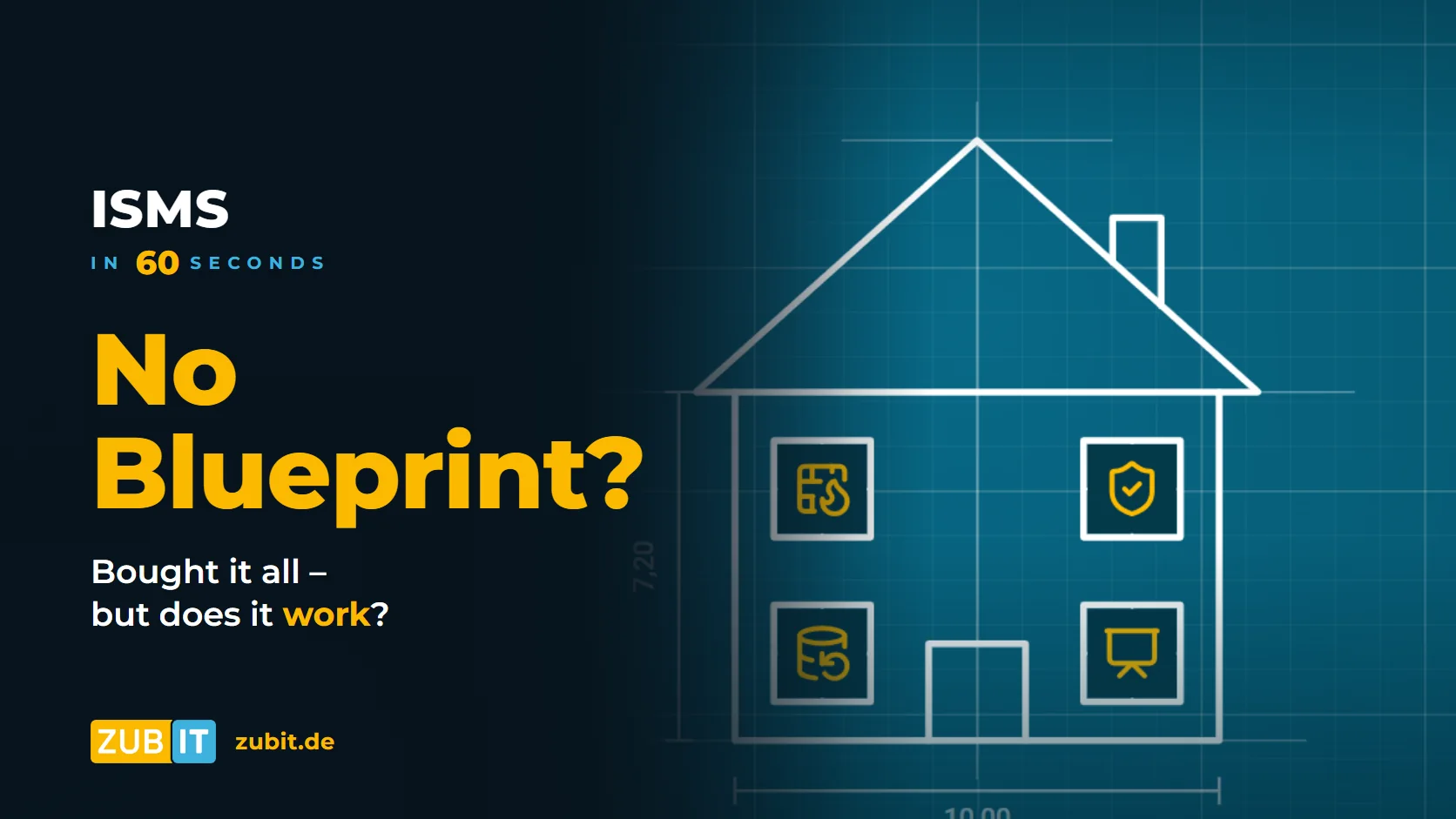
Nobody builds a house without a blueprint. First buy some windows, then a roof – and see whether it holds?
In IT security, many companies do exactly that. Firewall, antivirus, backup, training: everything has been bought. But does it actually work?
In short: What is an ISMS?
ISMS stands for information security management system. It is not a single product and not a binder on a shelf, but a set of fixed rules, responsibilities and processes. With it, a company plans its information security, implements it, checks it and keeps improving it. The best-known standard for it is ISO/IEC 27001.
Bought does not mean protected
Most companies invest in IT security regularly. But hardly anyone asks the decisive question: does it all actually work?
- Does every device really have up-to-date antivirus, or only almost every device?
- Has the training changed anything, or do people still click on every link?
- Who notices when a measure quietly stops working?
Often it is the attacker who notices first. One gap that nobody knows about is all they need. Why individual tools are not enough on their own is also explained in our article A firewall is not enough: defense in depth.
The ISMS is the blueprint
An ISMS turns individual parts into a system. It is not a one-off project but a cycle with four steps:
1. Clarify what matters and where the risks are
Which data, systems and processes does your company absolutely need? What happens if they fail or fall into the wrong hands? The answers show where the biggest risks are and what needs protecting first.
2. Define measures and responsibilities
For every important risk, you define what is done about it and who is responsible. Firewall, backup and training get their place in the plan and a name behind them.
3. Measure regularly whether it works
Key figures show whether the measures are effective: how many devices have up-to-date antivirus? When was a backup last restored successfully? How many employees still click the link in a test phishing email?
4. Improve what is missing
Whatever the measurement shows gets fixed: devices without antivirus get it, the training is adjusted. Then the cycle starts again.
Just like quality management
If you know quality management, you know the principle: plan, do, check, improve. An ISMS applies this cycle to information security.
Why it is a management task
Under the EU NIS2 directive, responsibility for information security lies explicitly with management. Management must approve the risk-management measures, oversee their implementation and take part in training. Whether a company falls directly under NIS2 depends on factors such as its sector and size.
But an ISMS helps even without a legal obligation: it shows where you stand and makes progress measurable.
Checklist for your business
- Do you know which data and systems matter most to your company?
- Is there a responsible person for every important security measure?
- Do you regularly measure whether the measures work, for example with key figures?
- Are gaps that are found tracked and closed?
- Is management involved and kept informed regularly?
Conclusion
Firewall, antivirus and backup are important building blocks. Only an ISMS turns them into a house that holds: it clarifies what matters, assigns responsibilities, measures the effect and keeps improving. You cannot buy security. You organise it.
Information security at zubIT
Build your ISMS with zubIT
With a certified IT security manager and lead auditor on our team, we build an ISMS with you that fits your company – including an inventory, risk analysis and clear key figures.
FAQ: Common questions about ISMS
What is an ISMS?
An ISMS (information security management system) is a system of rules, responsibilities and processes with which a company plans, implements, checks and continuously improves its information security. The best-known standard for it is ISO/IEC 27001.
How does an ISMS work?
As a cycle: first, you clarify what matters most and where the biggest risks are. Then measures and responsibilities are defined. After that, you regularly measure whether the measures work and improve what is missing.
Does my company need an ISMS?
Companies that fall under NIS2 must manage the risks to their IT systematically, and management is responsible for this. An ISMS is a proven way to implement this in an orderly manner. But even without an obligation, it shows whether the existing security measures work.
What is the difference between an ISMS and ISO 27001?
The ISMS is the management system within the company. ISO/IEC 27001 is the international standard that describes the requirements an ISMS should meet. An ISMS can be certified against it, but certification is not required to build one.